Innovation & Leadership

Research & Development

Community & Coaching

Case Study KOLEO

The research that revealed a product was serving the wrong user.
Product detail
  • What

    Usability Study

  • Role

    UX researcher

  • Participants

    6 users, 3 personas

  • Sector

    Transport

Strategic Impact

Research identified that Koleo's product strategy was optimised for casual travellers while systematically failing its highest-value segment — business users. This finding reframed the product problem from 'fix the usability issues' to 'decide which user you are building for.

  • About Koleo

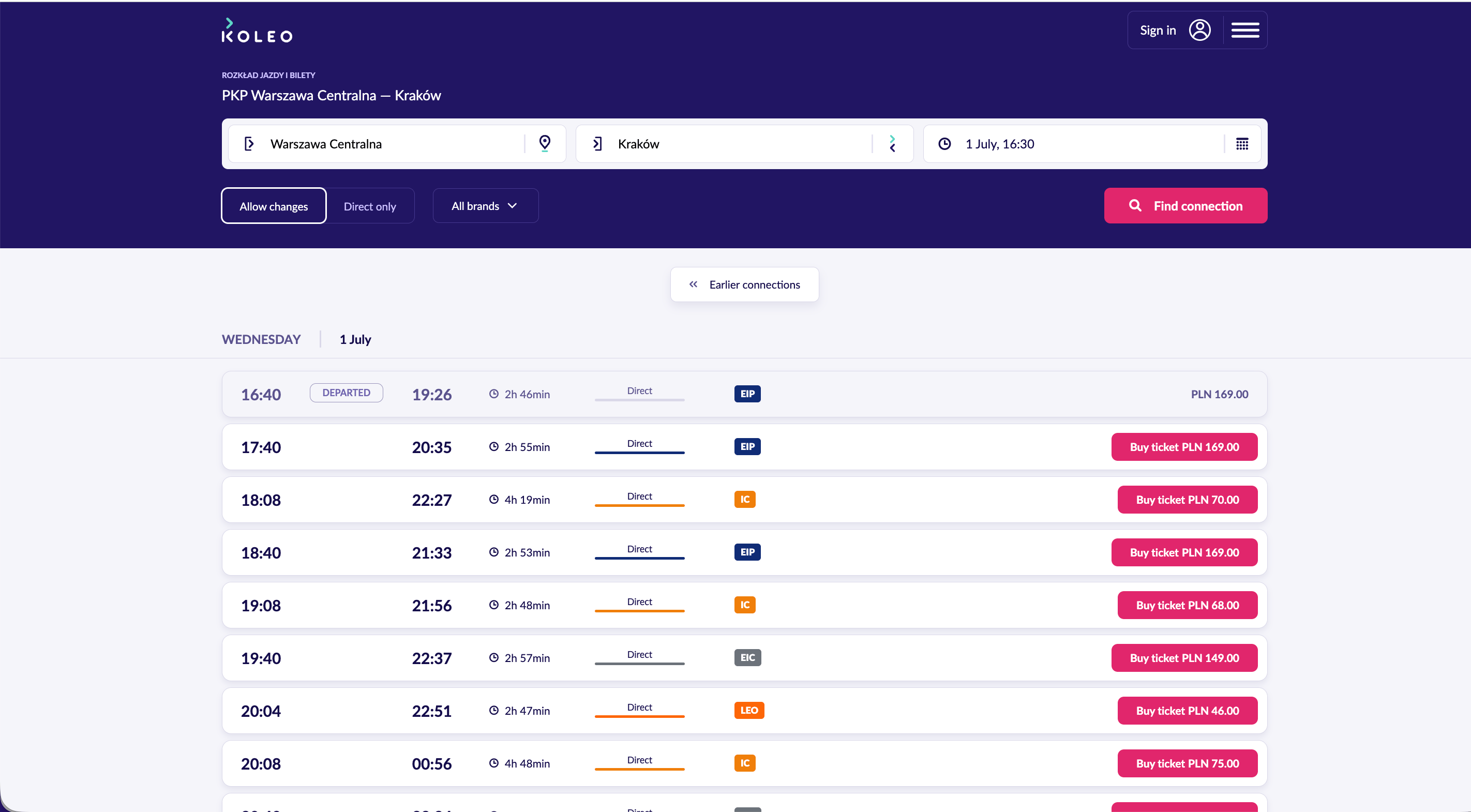
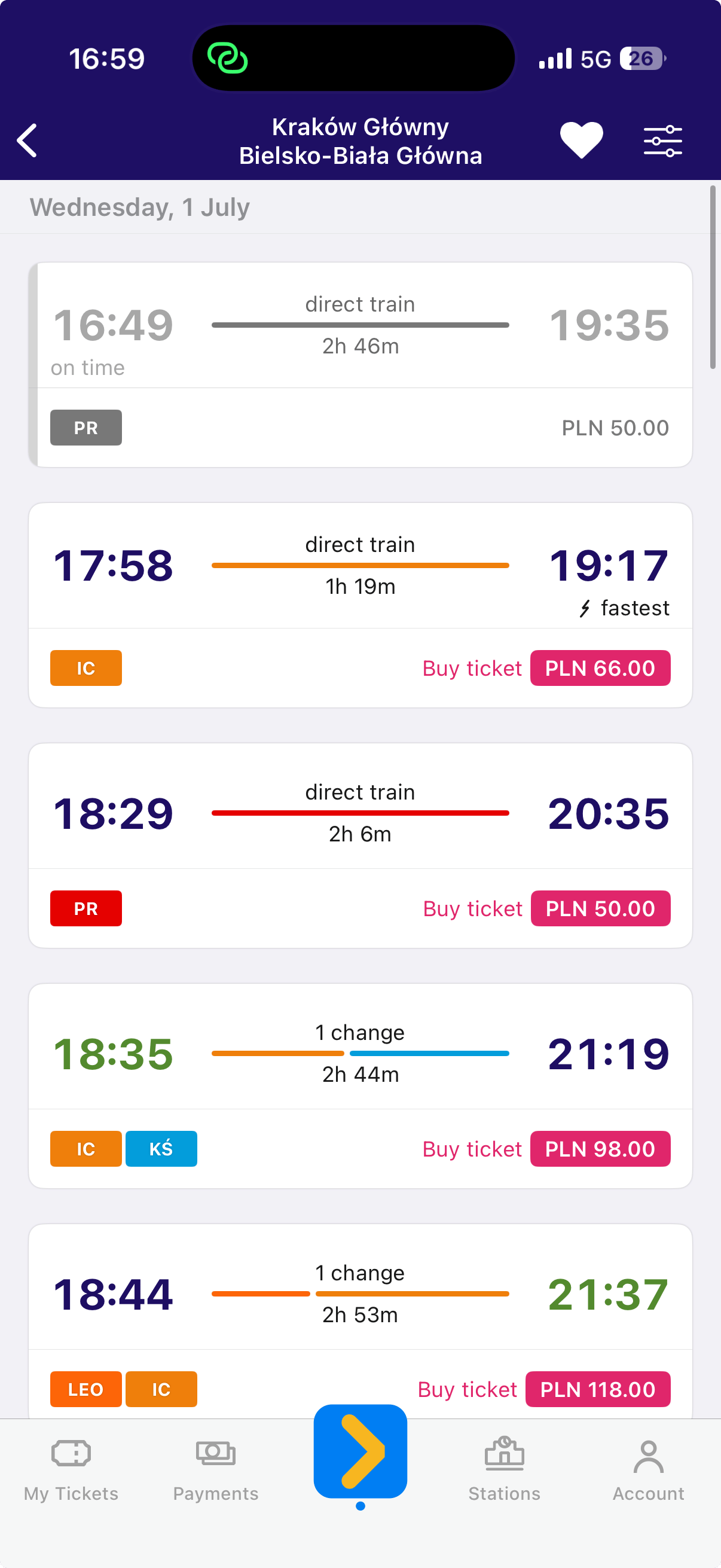
    Koleo is a Polish train ticket search and booking platform, bringing together multiple rail operators — PKP Intercity, Polregio, and regional carriers among them — into a single search and purchase flow. Founded in 2014 and based in Warsaw, it solves a structural problem specific to Poland's privatised rail system: no single operator sells tickets across the whole network, so Koleo exists as the aggregator layer that lets travellers compare and book across all of them in one place.

  • Research Setup

    Persona workshop with client before recruiting — three distinct mental models defined (student Ania, business traveller Krzysztof, occasional traveller pani Bogusia). 6 participants, 60–70 minute sessions, face-to-face and remote. Six realistic tasks stress-testing the flow across all three personas simultaneously.

    Key Findings

    Business users would not recommend Koleo. Casual users would. The NPS split between user types was the headline finding — a product serving two segments but optimised for only one. This reframed the client's question from 'what's broken?' to 'who are you building for?' — a product strategy decision, not a UX fix.
Conclusion: Takeaways

The NPS split reframed the brief from a usability audit into a strategy decision — and that's the pattern I look for in every research engagement. The interesting finding is rarely the broken button. It's the moment the data forces a client to choose who they're actually building for. Koleo's fixes were straightforward once the real question was on the table; getting to that question was the work.

Let's talk about what that could look like at your organisation. Contact me →

See All

Next project -->

Case Study KOLEO

The research that revealed a product was serving the wrong user.

Product detail
  • What

    Usability Study

  • Role

    UX researcher

  • Participants

    6 users, 3 personas

  • Sector

    Transport

Strategic Impact

Research identified that Koleo's product strategy was optimised for casual travellers while systematically failing its highest-value segment — business users. This finding reframed the product problem from 'fix the usability issues' to 'decide which user you are building for.

  • About Koleo

    Koleo is a Polish train ticket search and booking platform, bringing together multiple rail operators — PKP Intercity, Polregio, and regional carriers among them — into a single search and purchase flow. Founded in 2014 and based in Warsaw, it solves a structural problem specific to Poland's privatised rail system: no single operator sells tickets across the whole network, so Koleo exists as the aggregator layer that lets travellers compare and book across all of them in one place.

  • Research Setup

    Persona workshop with client before recruiting — three distinct mental models defined (student Ania, business traveller Krzysztof, occasional traveller pani Bogusia). 6 participants, 60–70 minute sessions, face-to-face and remote. Six realistic tasks stress-testing the flow across all three personas simultaneously.

    Key Findings

    Business users would not recommend Koleo. Casual users would. The NPS split between user types was the headline finding — a product serving two segments but optimised for only one. This reframed the client's question from 'what's broken?' to 'who are you building for?' — a product strategy decision, not a UX fix.
Conclusion: Takeaways

The NPS split reframed the brief from a usability audit into a strategy decision — and that's the pattern I look for in every research engagement. The interesting finding is rarely the broken button. It's the moment the data forces a client to choose who they're actually building for. Koleo's fixes were straightforward once the real question was on the table; getting to that question was the work.

Let's talk about what that could look like at your organisation. Contact me →

See All

Next project -->

Case Study KOLEO

The research that revealed a product was serving the wrong user.

Product detail
  • What

    Usability Study

  • Role

    UX researcher

  • Participants

    6 users, 3 personas

  • Sector

    Transport

Strategic Impact

Research identified that Koleo's product strategy was optimised for casual travellers while systematically failing its highest-value segment — business users. This finding reframed the product problem from 'fix the usability issues' to 'decide which user you are building for.

  • About Koleo

    Koleo is a Polish train ticket search and booking platform, bringing together multiple rail operators — PKP Intercity, Polregio, and regional carriers among them — into a single search and purchase flow. Founded in 2014 and based in Warsaw, it solves a structural problem specific to Poland's privatised rail system: no single operator sells tickets across the whole network, so Koleo exists as the aggregator layer that lets travellers compare and book across all of them in one place.

  • Research Setup

    Persona workshop with client before recruiting — three distinct mental models defined (student Ania, business traveller Krzysztof, occasional traveller pani Bogusia). 6 participants, 60–70 minute sessions, face-to-face and remote. Six realistic tasks stress-testing the flow across all three personas simultaneously.

    Key Findings

    Business users would not recommend Koleo. Casual users would. The NPS split between user types was the headline finding — a product serving two segments but optimised for only one. This reframed the client's question from 'what's broken?' to 'who are you building for?' — a product strategy decision, not a UX fix.

Conclusion: Takeaways

The NPS split reframed the brief from a usability audit into a strategy decision — and that's the pattern I look for in every research engagement. The interesting finding is rarely the broken button. It's the moment the data forces a client to choose who they're actually building for. Koleo's fixes were straightforward once the real question was on the table; getting to that question was the work.

Let's talk about what that could look like at your organisation. Contact me →

See All

Next project -->