Innovation & Leadership

Research & Development

Community & Coaching

Case Study IT R&D at Roche

The process that turned engineers into innovators.
Product detail
  • What

    Incubation & acceleration

    Role

    IT R&D Expert / Process Owner

  • Themes

    Data and AI, IoT, Blockchain, Quantum

    Scope

    Global - 4 divisions

Strategic Impact

By linking exploratory research directly to architecture decision-making, the department gave Roche’s senior leadership a structured way to weigh emerging technology against practical business priorities across four global divisions.

  • About Roche

    Roche is one of the world’s largest pharmaceutical and diagnostics companies, operating at global scale across research, development, and healthcare delivery. Its Global IT Solution Centre supports IT operations across the wider organisation, spanning multiple business divisions worldwide.

  • Strategy IT R&D

    The department built a formal collaboration framework connecting IT R&D to architecture governance across four global divisions — Pharma IT, FG, DIA IT, and GIS. This included a standardized process for submitting and evaluating new ideas, a backlog system for tracking them from concept through active research, and executive-ready formats for communicating findings to more than 20 senior stakeholders worldwide.

    Research Themes

    The IT R&D department researched technologies not yet adopted in Roche but potentially ready for wide implementation within 5–10 years. 2019 research priorities, mapped by strategic importance (strategic / opportunistic / moonshot), included: AI, intelligent assistants, hybrid BI/DS, IoT, intelligent automation, knowledge modelling, cloud adoption, blockchain, quantum computing, DevOps, data quality process & tools, and information architecture. Strategy themes for 2020 — Rapid Data Consumption, Cross-organisational Data Consumption, and Agile Architecture — covered both structured and unstructured data management at pharmaceutical scale, breaking down into epics such as Self-Driving Data Management, Cloud Data Lakes, Data Anonymization & Globalization, Data Storing & Sharing, Data Authentication/Verification/Validation, and Evolutionary Architecture.

    What I covered
    • Idea collection canvas and one-pager format — standardised submission and evaluation across the organisation

    • The IT R&D Canvas — the process's core scoping tool, built on Business Model Canvas / Lean Canvas logic, structuring Unique Value Proposition, Plan, Look Into, and Understand for every research proposal

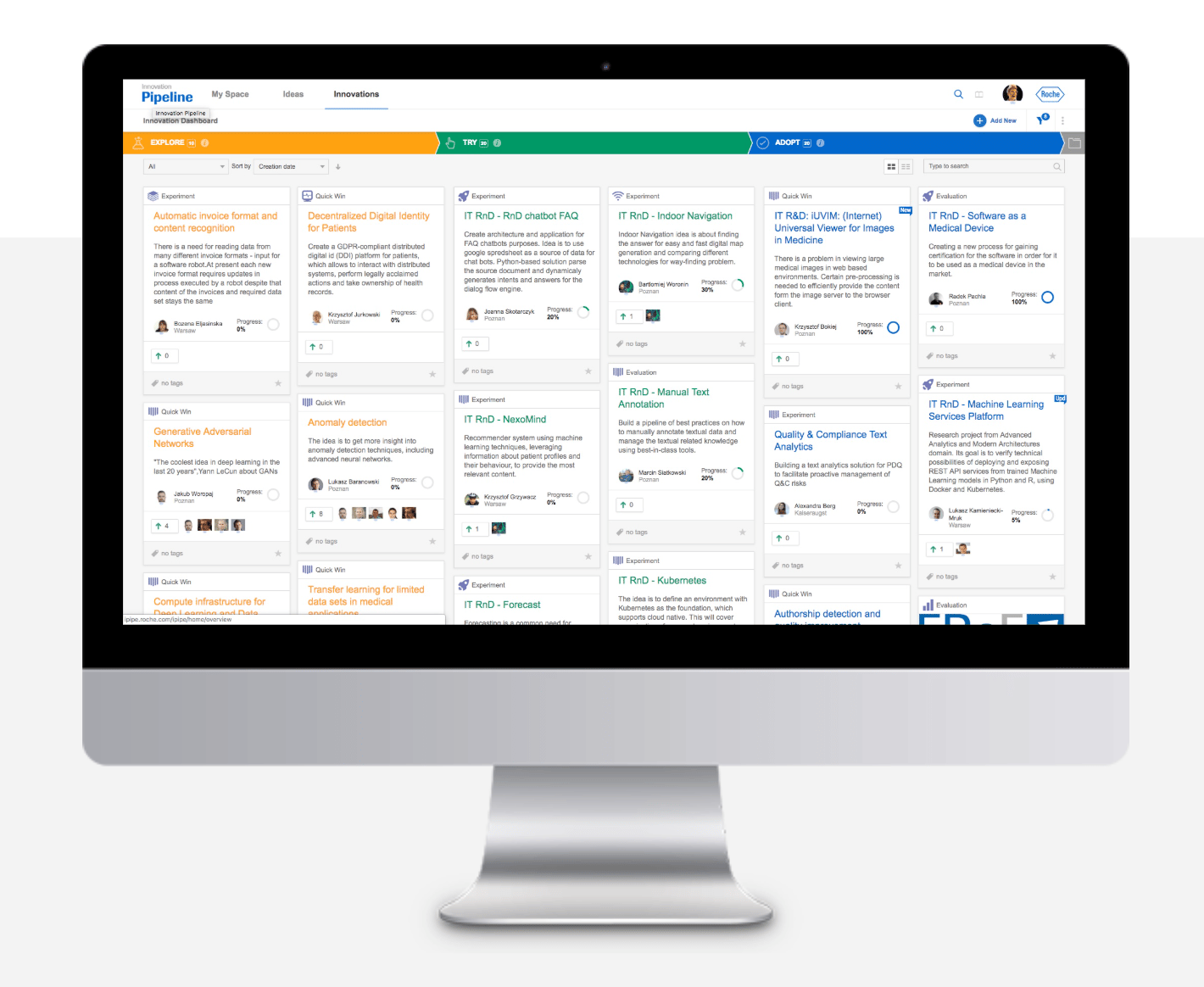
    • Backlog management process — how ideas moved from collection to active research, tracked publicly via the iPipe innovation pipeline portal

    • Research and whitepaper production process — communicating findings to 20+ named senior stakeholders globally, each research delivering a full whitepaper plus an executive summary

    • Executive summary format — distilling complex technology research for C-suite and senior architecture audiences

    • Review and prioritisation cadence — structured checkpoints connecting IT R&D output to GIAP decision-making

    • Positioned IT R&D within Solution Centre's wider innovation ecosystem — alongside the innovation-oriented Innovation Hub, technology-oriented Centres of Excellence, and business-oriented TC/BT pillars — clarifying idea intake, portfolio, budget, and resourcing ownership across the ecosystem
Strategic Impact

We provide insights about trending IT technologies that will lead our business into the future

The procoess

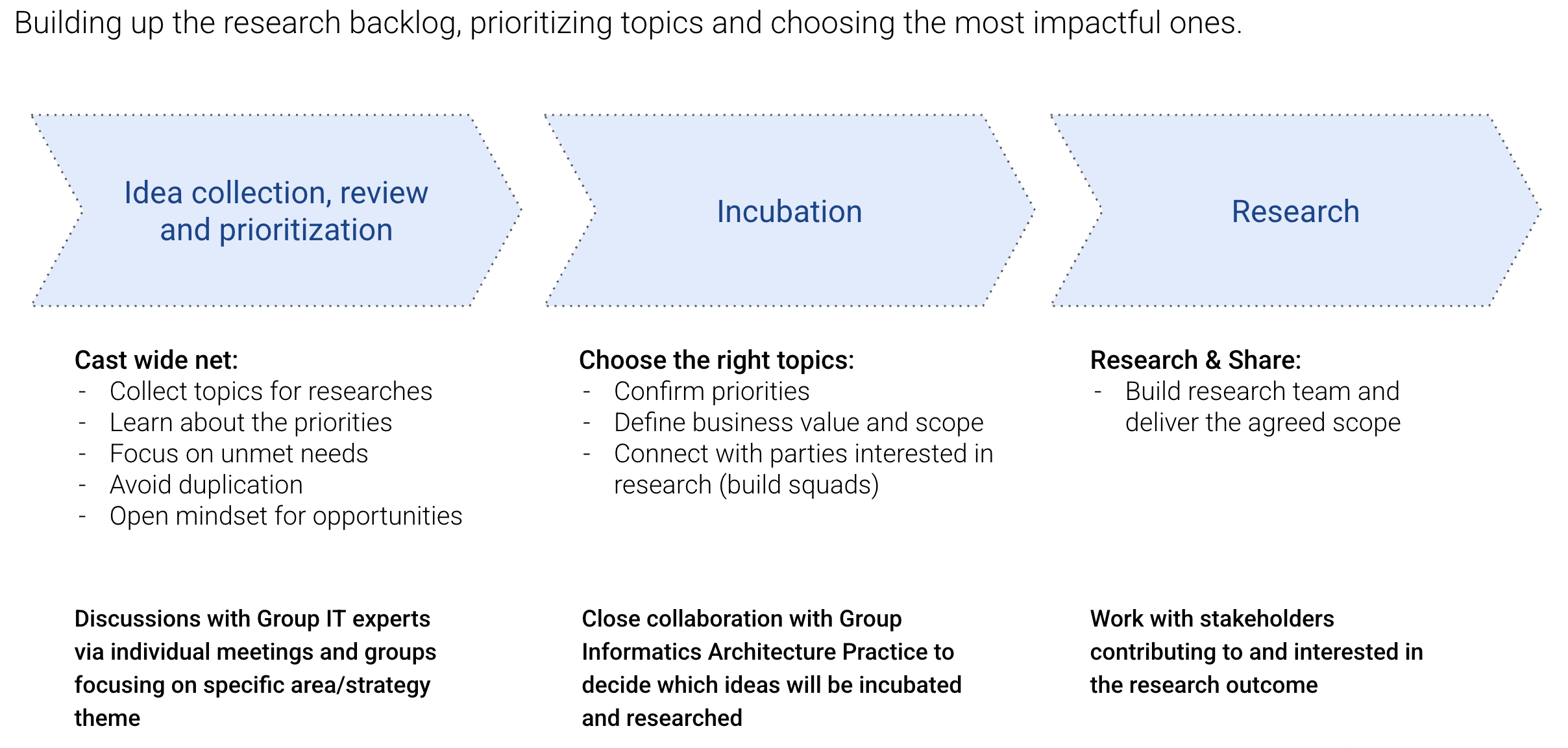
Building up the research backlog, prioritizing topics and choosing the most impactful ones.
IT R&D at a glance

  • Research Idea Collection

    Gathered 37 ideas from the organisation (roughly 3 a month); 25 moved into Incubation; 23 were passed on to IT Research; 19 were completed -

  • Time bound Research

    Each research running 2 to 9 months with an average project team of 4 people mostly with the outcomes - whitepapers, guidelines, positioning papers, technology showcases.

  • Transparency and knowledge sharing

    Managing a innovation pipeline via iPipe (internal platform software), creating a monthly newsletter, research presentation events, breakfasts

Head IT R&D

Roche Global IT Solution Centre

Sabrina transformed how we think about innovation. She didn't just run workshops — she built lasting capability. The frameworks and methods are now embedded in how we work.

Conclusion: Takeaways

Building the IT R&D x GIAP framework was less about the technology roadmap and more about giving research a route into decisions that mattered. A whitepaper nobody acts on is a filing exercise. Connecting research output to architecture governance — with a cadence, named owners, and a review checkpoint — is what turned five years of AI and emerging-tech research into something the organisation actually used, not just archived.

Let's talk about what that could look like at your organisation. Contact me →

Case Study IT R&D at Roche

The process that turned engineers into innovators.

Product detail
  • What

    Incubation & acceleration

    Role

    IT R&D Expert / Process Owner

  • Themes

    Data and AI, IoT, Blockchain, Quantum

    Scope

    Global - 4 divisions

Strategic Impact

By linking exploratory research directly to architecture decision-making, the department gave Roche’s senior leadership a structured way to weigh emerging technology against practical business priorities across four global divisions.

  • About Roche

    Roche is one of the world’s largest pharmaceutical and diagnostics companies, operating at global scale across research, development, and healthcare delivery. Its Global IT Solution Centre supports IT operations across the wider organisation, spanning multiple business divisions worldwide.

  • Strategy IT R&D

    The department built a formal collaboration framework connecting IT R&D to architecture governance across four global divisions — Pharma IT, FG, DIA IT, and GIS. This included a standardized process for submitting and evaluating new ideas, a backlog system for tracking them from concept through active research, and executive-ready formats for communicating findings to more than 20 senior stakeholders worldwide.

    Research Themes

    The IT R&D department researched technologies not yet adopted in Roche but potentially ready for wide implementation within 5–10 years. 2019 research priorities, mapped by strategic importance (strategic / opportunistic / moonshot), included: AI, intelligent assistants, hybrid BI/DS, IoT, intelligent automation, knowledge modelling, cloud adoption, blockchain, quantum computing, DevOps, data quality process & tools, and information architecture. Strategy themes for 2020 — Rapid Data Consumption, Cross-organisational Data Consumption, and Agile Architecture — covered both structured and unstructured data management at pharmaceutical scale, breaking down into epics such as Self-Driving Data Management, Cloud Data Lakes, Data Anonymization & Globalization, Data Storing & Sharing, Data Authentication/Verification/Validation, and Evolutionary Architecture.

    What I covered
    • Idea collection canvas and one-pager format — standardised submission and evaluation across the organisation

    • The IT R&D Canvas — the process's core scoping tool, built on Business Model Canvas / Lean Canvas logic, structuring Unique Value Proposition, Plan, Look Into, and Understand for every research proposal

    • Backlog management process — how ideas moved from collection to active research, tracked publicly via the iPipe innovation pipeline portal

    • Research and whitepaper production process — communicating findings to 20+ named senior stakeholders globally, each research delivering a full whitepaper plus an executive summary

    • Executive summary format — distilling complex technology research for C-suite and senior architecture audiences

    • Review and prioritisation cadence — structured checkpoints connecting IT R&D output to GIAP decision-making

    • Positioned IT R&D within Solution Centre's wider innovation ecosystem — alongside the innovation-oriented Innovation Hub, technology-oriented Centres of Excellence, and business-oriented TC/BT pillars — clarifying idea intake, portfolio, budget, and resourcing ownership across the ecosystem

Strategic Impact

We provide insights about trending IT technologies that will lead our business into the future

The procoess

Building up the research backlog, prioritizing topics and choosing the most impactful ones.

IT R&D at a glance

  • Research Idea Collection

    Gathered 37 ideas from the organisation (roughly 3 a month); 25 moved into Incubation; 23 were passed on to IT Research; 19 were completed -

  • Time bound Research

    Each research running 2 to 9 months with an average project team of 4 people mostly with the outcomes - whitepapers, guidelines, positioning papers, technology showcases.

  • Transparency and knowledge sharing

    Managing a innovation pipeline via iPipe (internal platform software), creating a monthly newsletter, research presentation events, breakfasts

Head IT R&D

Roche Global IT Solution Centre

Sabrina transformed how we think about innovation. She didn't just run workshops — she built lasting capability. The frameworks and methods are now embedded in how we work.

Conclusion: Takeaways

Building the IT R&D x GIAP framework was less about the technology roadmap and more about giving research a route into decisions that mattered. A whitepaper nobody acts on is a filing exercise. Connecting research output to architecture governance — with a cadence, named owners, and a review checkpoint — is what turned five years of AI and emerging-tech research into something the organisation actually used, not just archived.

Let's talk about what that could look like at your organisation. Contact me →

Case Study IT R&D at Roche

The process that turned engineers into innovators.

Product detail
  • What

    Incubation & acceleration

    Role

    IT R&D Expert / Process Owner

  • Themes

    Data and AI, IoT, Blockchain, Quantum

    Scope

    Global - 4 divisions

Strategic Impact

By linking exploratory research directly to architecture decision-making, the department gave Roche’s senior leadership a structured way to weigh emerging technology against practical business priorities across four global divisions.

  • About Roche

    Roche is one of the world’s largest pharmaceutical and diagnostics companies, operating at global scale across research, development, and healthcare delivery. Its Global IT Solution Centre supports IT operations across the wider organisation, spanning multiple business divisions worldwide.

  • Strategy IT R&D

    The department built a formal collaboration framework connecting IT R&D to architecture governance across four global divisions — Pharma IT, FG, DIA IT, and GIS. This included a standardized process for submitting and evaluating new ideas, a backlog system for tracking them from concept through active research, and executive-ready formats for communicating findings to more than 20 senior stakeholders worldwide.

    Research Themes

    The IT R&D department researched technologies not yet adopted in Roche but potentially ready for wide implementation within 5–10 years. 2019 research priorities, mapped by strategic importance (strategic / opportunistic / moonshot), included: AI, intelligent assistants, hybrid BI/DS, IoT, intelligent automation, knowledge modelling, cloud adoption, blockchain, quantum computing, DevOps, data quality process & tools, and information architecture. Strategy themes for 2020 — Rapid Data Consumption, Cross-organisational Data Consumption, and Agile Architecture — covered both structured and unstructured data management at pharmaceutical scale, breaking down into epics such as Self-Driving Data Management, Cloud Data Lakes, Data Anonymization & Globalization, Data Storing & Sharing, Data Authentication/Verification/Validation, and Evolutionary Architecture.

    What I covered
    • Idea collection canvas and one-pager format — standardised submission and evaluation across the organisation

    • The IT R&D Canvas — the process's core scoping tool, built on Business Model Canvas / Lean Canvas logic, structuring Unique Value Proposition, Plan, Look Into, and Understand for every research proposal

    • Backlog management process — how ideas moved from collection to active research, tracked publicly via the iPipe innovation pipeline portal

    • Research and whitepaper production process — communicating findings to 20+ named senior stakeholders globally, each research delivering a full whitepaper plus an executive summary

    • Executive summary format — distilling complex technology research for C-suite and senior architecture audiences

    • Review and prioritisation cadence — structured checkpoints connecting IT R&D output to GIAP decision-making

    • Positioned IT R&D within Solution Centre's wider innovation ecosystem — alongside the innovation-oriented Innovation Hub, technology-oriented Centres of Excellence, and business-oriented TC/BT pillars — clarifying idea intake, portfolio, budget, and resourcing ownership across the ecosystem

Strategic Impact

We provide insights about trending IT technologies that will lead our business into the future

The procoess

Building up the research backlog, prioritizing topics and choosing the most impactful ones.

IT R&D at a glance

  • Research Idea Collection

    Gathered 37 ideas from the organisation (roughly 3 a month); 25 moved into Incubation; 23 were passed on to IT Research; 19 were completed -

  • Time bound Research

    Each research running 2 to 9 months with an average project team of 4 people mostly with the outcomes - whitepapers, guidelines, positioning papers, technology showcases.

  • Transparency and knowledge sharing

    Managing a innovation pipeline via iPipe (internal platform software), creating a monthly newsletter, research presentation events, breakfasts

Head IT R&D

Roche Global IT Solution Centre

Sabrina transformed how we think about innovation. She didn't just run workshops — she built lasting capability. The frameworks and methods are now embedded in how we work.

Conclusion: Takeaways

Building the IT R&D x GIAP framework was less about the technology roadmap and more about giving research a route into decisions that mattered. A whitepaper nobody acts on is a filing exercise. Connecting research output to architecture governance — with a cadence, named owners, and a review checkpoint — is what turned five years of AI and emerging-tech research into something the organisation actually used, not just archived.

Let's talk about what that could look like at your organisation. Contact me →

See all

Next project -->