Innovation & Leadership

Research & Development

Community & Coaching

Case Study Volta

Charging, without the guesswork.
  • Role

    Research & Design

    What

    Mobile

    Team

    Solo

    Sector

    Transport

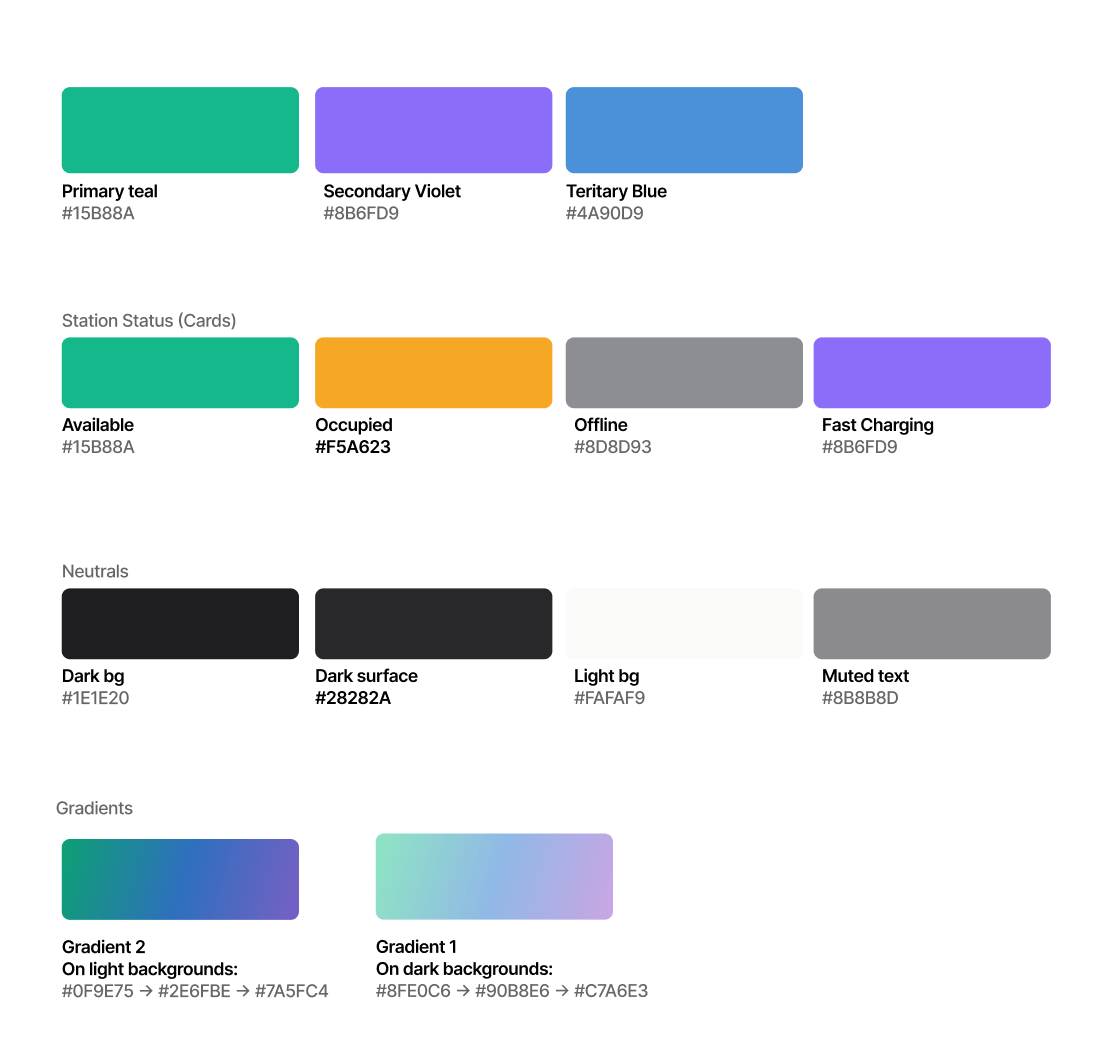
Strategic Impact

Volta reframes Swiss public EV charging around trust, not just coverage.

  • About Volta

    A solo, end-to-end UX/UI project — research, concept, interface design, prototyping, and brand identity — completed during the UX/UI Summer Camp at FHNW (Fachhochschule Nordwestschweiz), Basel.

    Research into the Swiss charging market surfaced a problem most competitors don't solve: drivers don't just need more chargers listed, they need to believe a charger will actually work, cost what it says, and not require a third app. I owned the project end to end — market research, persona and problem definition, value proposition, product scope, full screen design in Figma, and the brand identity — as a solo project.

  • Context

    Public EV charging in Switzerland is fragmented, and drivers can't fully trust it. Most Swiss residents rent their homes, so a private wallbox isn't a decision they can make alone — it needs landlord buy-in first, and often isn't possible at all. That pushes a large share of EV drivers onto public charging by default.

    No single operator covers the country, so drivers typically run two to three apps (evpass, Swisscharge, MOVE, GOFAST, Green Motion, Ionity) to feel covered. And an "available" label on a map isn't the same as a charger that actually works.

    Existing apps like Chargemap, Z-Volt, and TCS eCharge solve for coverage, not for trust or price clarity. Meanwhile the market is consolidating: utilities are vertically integrating into charging networks, and Shell's 2025 acquisition of evpass signalled that consolidation is accelerating — without yet solving the fragmentation drivers feel.

    The Primary Challenge

    How might we help EV drivers in Switzerland find, trust, and use public charging stations — without needing multiple apps or crossing their fingers that it'll actually work?

Research: The Numbers Behind the Problem

  • ~14,000

    Public charging points in Switzerland (Q1 2026)

    ~85%

    Charging sessions succeed on the first try — 1 in 7 don't

  • 2x

    Price difference for the same 50 kWh charge (CHF 23–46)

    76%

    Roaming surcharge when paying on another network

Value Proposition

Volta is the one app Swiss EV drivers need to find, trust, pay for, and track their charging.

  • Brand design incl. name

Proto Personas

Nina Herzog, 34

Marketing Manager, Basel

VW ID.3

  • Context

    Rents her apartment, no home charger by circumstance, not choice; depends entirely on public charging on weekday evenings and weekends.

    Pain Points

    Has arrived at a station to find it occupied or broken more than once, juggles three apps because no single operator covers her area, and has been caught out by how differently the same charge is priced across networks.

    Needs

    Clear plug-type filtering, a real confidence signal instead of a bare "available" label, and one consistent view of price.

Marco Bühler, 52

Sales Representative , Basel

Škoda Enyaq

  • Context

    Drives frequently between cities. An experienced EV driver who still finds cross-network trip planning stressful, since no operator covers the whole country.

    Pain Points

    Cross-network trip planning remains stressful despite experience.

    Needs

    Fast-charger-first filtering along his route, a one-tap start using a saved vehicle and payment profile, automatic spend tracking for expense reporting, and notifications rather than having to babysit the app between meetings.

Chosen screens

Customiser

Charging costs

Conclusion: Takeaways

Volta shows end-to-end ownership — research, concept, UI design, and brand identity built solo on a compressed timeline. Every stat and problem statement traces directly to a persona need or a value-proposition reframe, and two distinct personas shaped genuinely different feature priorities within one coherent scope, not just a longer feature list. The result is advanced Figma craft — variables, component variants, smart-animate prototyping — used in service of a product decision, not as a technique showcase

Let's talk about what that could look like at your organisation. Contact me →

Case Study Volta

Charging, without the guesswork.
  • Role

    Research & Design

    What

    Mobile

    Team

    Solo

    Sector

    Transport

Strategic Impact

Volta reframes Swiss public EV charging around trust, not just coverage.

  • About Volta

    A solo, end-to-end UX/UI project — research, concept, interface design, prototyping, and brand identity — completed during the UX/UI Summer Camp at FHNW (Fachhochschule Nordwestschweiz), Basel.

    Research into the Swiss charging market surfaced a problem most competitors don't solve: drivers don't just need more chargers listed, they need to believe a charger will actually work, cost what it says, and not require a third app. I owned the project end to end — market research, persona and problem definition, value proposition, product scope, full screen design in Figma, and the brand identity — as a solo project.

  • Context

    Public EV charging in Switzerland is fragmented, and drivers can't fully trust it. Most Swiss residents rent their homes, so a private wallbox isn't a decision they can make alone — it needs landlord buy-in first, and often isn't possible at all. That pushes a large share of EV drivers onto public charging by default.

    No single operator covers the country, so drivers typically run two to three apps (evpass, Swisscharge, MOVE, GOFAST, Green Motion, Ionity) to feel covered. And an "available" label on a map isn't the same as a charger that actually works.

    Existing apps like Chargemap, Z-Volt, and TCS eCharge solve for coverage, not for trust or price clarity. Meanwhile the market is consolidating: utilities are vertically integrating into charging networks, and Shell's 2025 acquisition of evpass signalled that consolidation is accelerating — without yet solving the fragmentation drivers feel.

    The Primary Challenge

    How might we help EV drivers in Switzerland find, trust, and use public charging stations — without needing multiple apps or crossing their fingers that it'll actually work?

Research: The Numbers Behind the Problem

  • ~14,000

    Public charging points in Switzerland (Q1 2026)

    ~85%

    Charging sessions succeed on the first try — 1 in 7 don't

  • 2x

    Price difference for the same 50 kWh charge (CHF 23–46)

    76%

    Roaming surcharge when paying on another network

Value Proposition

Volta is the one app Swiss EV drivers need to find, trust, pay for, and track their charging.

  • Brand design incl. name

Proto Personas

Nina Herzog, 34

Marketing Manager, Basel

VW ID.3

  • Context

    Rents her apartment, no home charger by circumstance, not choice; depends entirely on public charging on weekday evenings and weekends.

    Pain Points

    Has arrived at a station to find it occupied or broken more than once, juggles three apps because no single operator covers her area, and has been caught out by how differently the same charge is priced across networks.

    Needs

    Clear plug-type filtering, a real confidence signal instead of a bare "available" label, and one consistent view of price.

Marco Bühler, 52

Sales Representative , Basel

Škoda Enyaq

  • Context

    Drives frequently between cities. An experienced EV driver who still finds cross-network trip planning stressful, since no operator covers the whole country.

    Pain Points

    Cross-network trip planning remains stressful despite experience.

    Needs

    Fast-charger-first filtering along his route, a one-tap start using a saved vehicle and payment profile, automatic spend tracking for expense reporting, and notifications rather than having to babysit the app between meetings.

Chosen screens
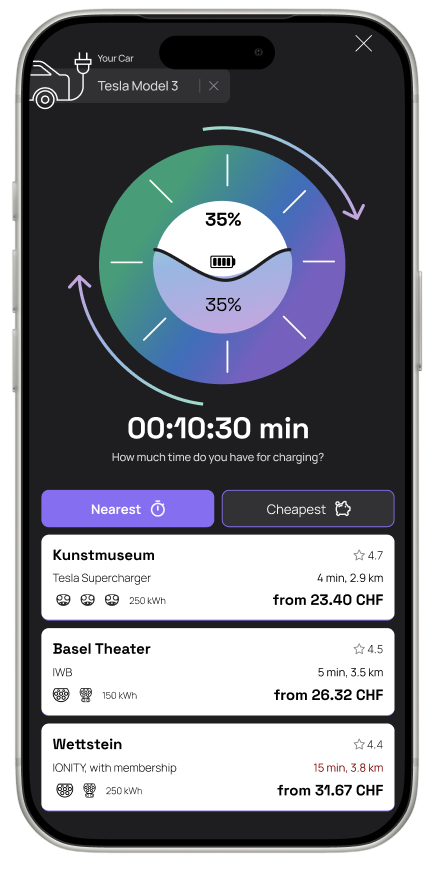
Customiser
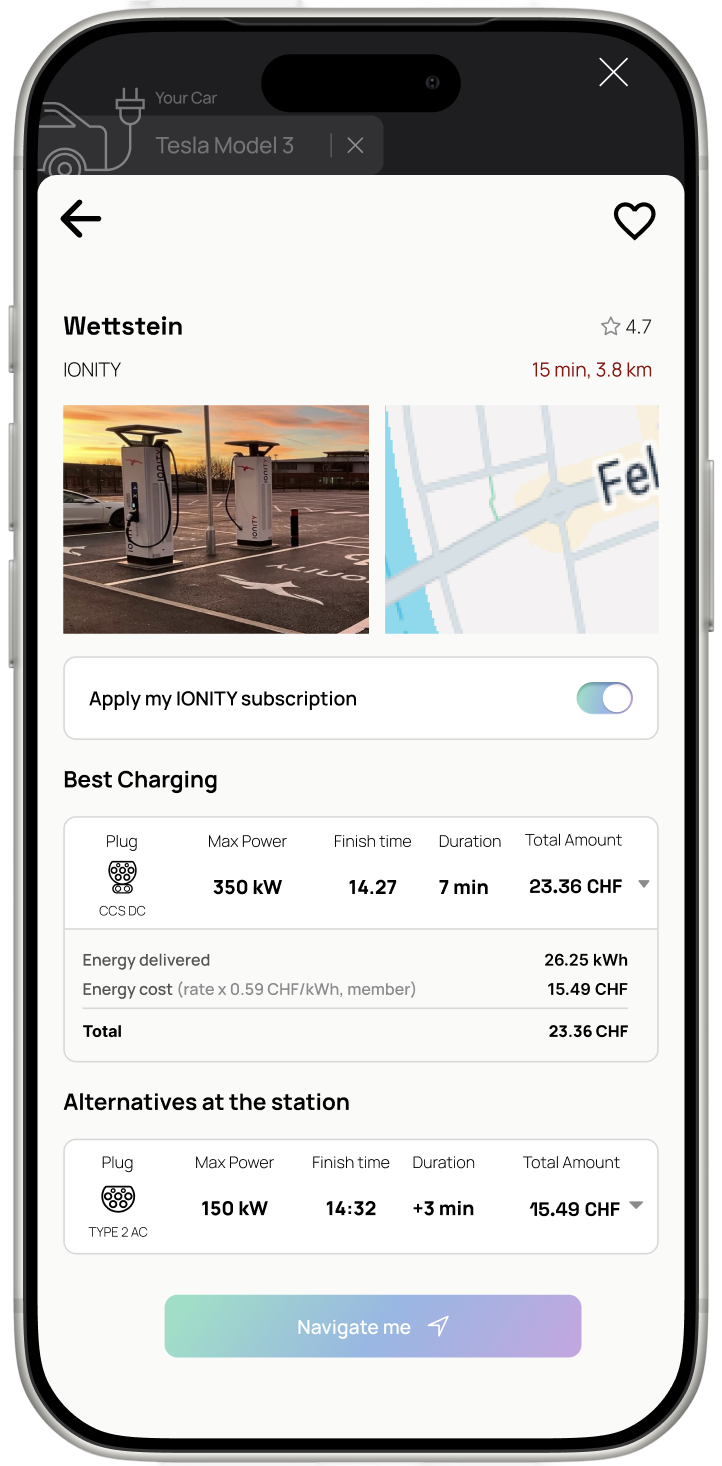
Charging costs

Conclusion: Takeaways

Volta shows end-to-end ownership — research, concept, UI design, and brand identity built solo on a compressed timeline. Every stat and problem statement traces directly to a persona need or a value-proposition reframe, and two distinct personas shaped genuinely different feature priorities within one coherent scope, not just a longer feature list. The result is advanced Figma craft — variables, component variants, smart-animate prototyping — used in service of a product decision, not as a technique showcase

Let's talk about what that could look like at your organisation. Contact me →
Case Study Volta

Charging, without the guesswork.

  • Role

    Research & Design

    What

    Mobile

    Team

    Solo

    Sector

    Transport

Strategic Impact

Volta reframes Swiss public EV charging around trust, not just coverage.

  • About Volta

    A solo, end-to-end UX/UI project — research, concept, interface design, prototyping, and brand identity — completed during the UX/UI Summer Camp at FHNW (Fachhochschule Nordwestschweiz), Basel.

    Research into the Swiss charging market surfaced a problem most competitors don't solve: drivers don't just need more chargers listed, they need to believe a charger will actually work, cost what it says, and not require a third app. I owned the project end to end — market research, persona and problem definition, value proposition, product scope, full screen design in Figma, and the brand identity — as a solo project.

  • Context

    Public EV charging in Switzerland is fragmented, and drivers can't fully trust it. Most Swiss residents rent their homes, so a private wallbox isn't a decision they can make alone — it needs landlord buy-in first, and often isn't possible at all. That pushes a large share of EV drivers onto public charging by default.

    No single operator covers the country, so drivers typically run two to three apps (evpass, Swisscharge, MOVE, GOFAST, Green Motion, Ionity) to feel covered. And an "available" label on a map isn't the same as a charger that actually works.

    Existing apps like Chargemap, Z-Volt, and TCS eCharge solve for coverage, not for trust or price clarity. Meanwhile the market is consolidating: utilities are vertically integrating into charging networks, and Shell's 2025 acquisition of evpass signalled that consolidation is accelerating — without yet solving the fragmentation drivers feel.

    The Primary Challenge

    How might we help EV drivers in Switzerland find, trust, and use public charging stations — without needing multiple apps or crossing their fingers that it'll actually work?

Research: The Numbers Behind the Problem

  • ~14,000

    Public charging points in Switzerland (Q1 2026)

    ~85%

    Charging sessions succeed on the first try — 1 in 7 don't

  • 2x

    Price difference for the same 50 kWh charge (CHF 23–46)

    76%

    Roaming surcharge when paying on another network

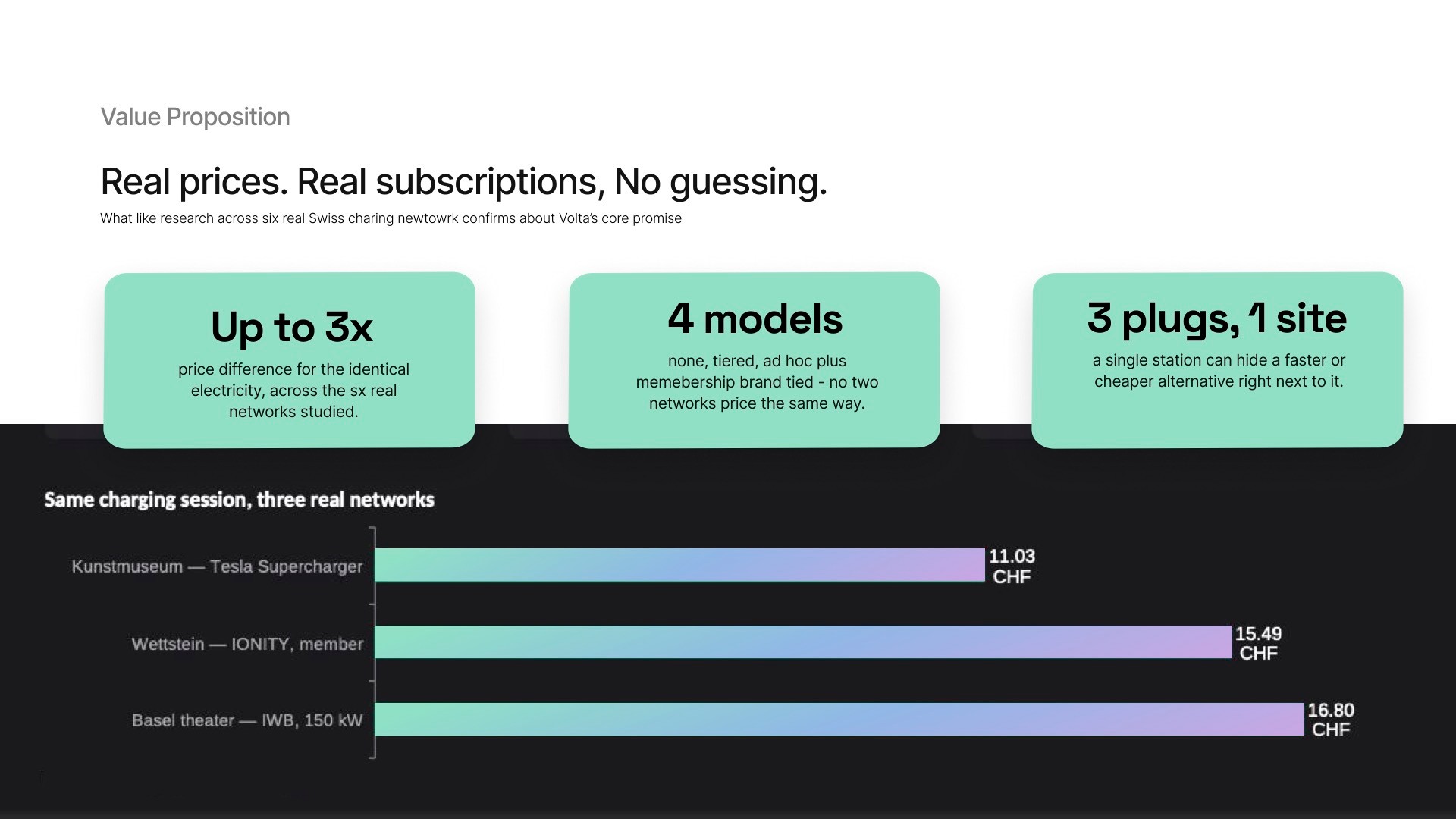
Value Proposition

Volta is the one app Swiss EV drivers need to find, trust, pay for, and track their charging.

  • Brand design incl. name

Proto Personas

Nina Herzog, 34

Marketing Manager, Basel

VW ID.3

  • Context

    Rents her apartment, no home charger by circumstance, not choice; depends entirely on public charging on weekday evenings and weekends.

    Pain Points

    Has arrived at a station to find it occupied or broken more than once, juggles three apps because no single operator covers her area, and has been caught out by how differently the same charge is priced across networks.

    Needs

    Clear plug-type filtering, a real confidence signal instead of a bare "available" label, and one consistent view of price.

Marco Bühler, 52

Sales Representative , Basel

Škoda Enyaq

  • Context

    Drives frequently between cities. An experienced EV driver who still finds cross-network trip planning stressful, since no operator covers the whole country.

    Pain Points

    Cross-network trip planning remains stressful despite experience.

    Needs

    Fast-charger-first filtering along his route, a one-tap start using a saved vehicle and payment profile, automatic spend tracking for expense reporting, and notifications rather than having to babysit the app between meetings.

Chosen screens

Customiser

Charging costs

Conclusion: Takeaways

Volta shows end-to-end ownership — research, concept, UI design, and brand identity built solo on a compressed timeline. Every stat and problem statement traces directly to a persona need or a value-proposition reframe, and two distinct personas shaped genuinely different feature priorities within one coherent scope, not just a longer feature list. The result is advanced Figma craft — variables, component variants, smart-animate prototyping — used in service of a product decision, not as a technique showcase

Let's talk about what that could look like at your organisation. Contact me →